First Aid Can Save Lives: What Everyone Should Know During a Medical Emergency
A medical emergency can happen anywhere and at any time. It may occur at home, at work, on the road, at school, during exercise, or in a public place. In many emergencies, the first few minutes can be extremely important. First aid refers to the immediate assistance provided to a person who is injured or suddenly becomes ill before professional medical care is available. It does not replace treatment by doctors or emergency medical teams. However, appropriate first aid can help prevent a condition from becoming worse, protect the person from additional injury, and provide valuable support while professional help is being arranged.
Knowing basic first aid is not only useful for healthcare professionals. Parents, teachers, students, office employees, drivers, caregivers, and members of the public can all benefit from understanding what to do during common emergencies. The most important principle is to remain calm, assess the situation, protect yourself and the patient, call for professional help when required, and provide appropriate first aid without causing further harm. At East Point Hospital, our Emergency Medicine and critical care teams provide round-the-clock medical care for patients requiring urgent evaluation and treatment.
What Is First Aid?
First aid is the immediate care provided to someone who has been injured or suddenly becomes unwell.
Its main purposes are to:
- Preserve life
- Prevent the condition from worsening
- Reduce pain and distress
- Protect the person from further injury
- Support recovery until professional medical care is available
First aid may be as simple as applying pressure to a bleeding wound or positioning an unconscious but breathing person safely.
In serious emergencies, first aid may include CPR while waiting for emergency medical services.
The First Rule: Make Sure the Scene Is Safe
Before helping another person, look around and make sure you are not putting yourself in danger.
Potential hazards may include:
- Traffic
- Fire
- Electrical wires
- Gas leaks
- Dangerous machinery
- Chemicals
- Violence
- Unstable structures
A rescuer who becomes injured may no longer be able to help the patient.
Once the scene is reasonably safe, assess the person and call for appropriate emergency assistance.
What Should You Do First During an Emergency?
A simple approach is:
Stay calm → Check safety → Check responsiveness → Call for help → Provide appropriate first aid → Monitor the person until help arrives.
If the person is unresponsive, not breathing normally, has severe bleeding, or has another life-threatening condition, emergency medical assistance should be activated immediately.
CPR: What to Do if Someone Is Unresponsive and Not Breathing Normally
Cardiac arrest is a life-threatening emergency in which the heart stops effectively pumping blood.
If an adult suddenly collapses and is unresponsive and not breathing normally, CPR should be started as soon as possible while emergency medical help is activated.
CPR generally involves repeated chest compressions to help circulate blood to vital organs.
If an automated external defibrillator (AED) is available, it should be used according to its instructions.
People who regularly work with children, older adults, patients, or large groups may benefit from formal CPR and first-aid training.
First Aid for Severe Bleeding
Severe bleeding can become life-threatening if not controlled promptly.
If a person has significant external bleeding:
Apply firm, direct pressure to the wound using clean cloth, gauze, or a dressing.
Continue pressure and seek emergency medical assistance.
If blood soaks through the dressing, additional material can be placed over it while maintaining pressure.
Do not repeatedly remove the original dressing to inspect the wound.
Very deep wounds, uncontrolled bleeding, or injuries involving major blood vessels require urgent medical treatment.
First Aid for Burns
Burns may result from:
- Hot liquids
- Fire
- Steam
- Hot surfaces
- Chemicals
- Electricity
For a minor thermal burn, cool running water can be used to cool the affected area.
Avoid applying substances such as:
- Toothpaste
- Butter
- Oil
- Household creams not intended for burns
These may worsen the injury or interfere with medical assessment.
Large burns, deep burns, electrical burns, chemical burns, burns involving the face or airway, and burns in young children require urgent medical evaluation.
First Aid for Choking
Choking occurs when an object blocks the airway.
A person with a serious airway obstruction may be unable to:
- Speak
- Breathe
- Cough effectively
This is a medical emergency.
If a person is choking and cannot breathe or cough effectively, appropriate first-aid manoeuvres should be performed according to current first-aid training, while emergency medical help is activated.
If the person becomes unresponsive, CPR should be started and emergency assistance should be obtained.
Do not blindly put your fingers into someone’s mouth to search for an object, as this may push the object deeper.
What to Do During a Seizure
Seizures can be frightening for family members and bystanders.
The primary goal is to protect the person from injury.
Move dangerous objects away and, if possible, place something soft under the person’s head.
Do not:
- Hold the person down
- Put anything inside the person’s mouth
- Force food or water into the mouth
After the seizure, monitor the person and ensure they are breathing normally.
Emergency medical attention is particularly important if:
- It is the person’s first known seizure.
- The seizure lasts unusually long.
- Seizures occur repeatedly without recovery.
- The person is seriously injured.
- Breathing remains abnormal.
- The seizure occurs in water.
- The person is pregnant or has another serious medical condition.
First Aid for Fainting
Fainting is a temporary loss of consciousness caused by reduced blood flow to the brain.
If someone faints, make sure the surrounding area is safe and allow them to lie down.
Check whether they respond and are breathing normally.
If the person does not regain consciousness promptly, has difficulty breathing, has chest pain, has sustained an injury, or has other concerning symptoms, emergency medical evaluation is required.
Repeated episodes of fainting should be medically assessed to determine the underlying cause.
Suspected Heart Attack: Act Quickly
A heart attack occurs when blood flow to part of the heart muscle becomes blocked.
Warning signs may include:
- Pressure or discomfort in the chest
- Pain spreading to the arm, shoulder, back, neck, or jaw
- Shortness of breath
- Sweating
- Nausea
- Unusual weakness
Symptoms can vary, and some people—particularly women, older adults, and people with diabetes—may have less typical symptoms.
A suspected heart attack should be treated as an emergency.
Do not wait for symptoms to disappear. Seek emergency medical care immediately.
Recognising a Stroke
Stroke requires rapid medical attention because brain tissue can be damaged when blood flow is interrupted.
Remember the warning signs:
Face
Ask the person to smile. Is one side of the face drooping?
Arms
Ask them to raise both arms. Is one arm weak or drifting downward?
Speech
Ask them to speak. Is their speech slurred or difficult to understand?
Time
If these symptoms appear suddenly, seek emergency medical assistance immediately.
Do not wait to see whether symptoms improve.
Rapid treatment can significantly influence outcomes.
First Aid for Fractures
A fracture is a break in a bone.
Possible signs include:
- Severe pain
- Swelling
- Bruising
- Deformity
- Difficulty moving the affected area
Avoid unnecessary movement of the injured limb.
Do not attempt to straighten an obviously deformed bone.
Immobilize the area as safely as possible and seek medical attention.
Suspected spinal injuries require particularly careful handling and should not be moved unnecessarily unless there is immediate danger.
Head Injuries
Head injuries may occur during:
- Road accidents
- Falls
- Sports
- Workplace accidents
A person with a head injury should be evaluated urgently if there is:
- Loss of consciousness
- Repeated vomiting
- Increasing headache
- Confusion
- Seizures
- Weakness
- Difficulty speaking
- Unusual behaviour
- Excessive drowsiness
Children and older adults may require particularly careful assessment after head injuries.
Poisoning and Chemical Exposure
If someone may have swallowed a poisonous substance, do not automatically induce vomiting.
Keep the container or product information available if possible and seek urgent medical advice.
Chemical exposure to the eyes or skin may require immediate prolonged washing with clean running water, depending on the substance.
Serious poisoning requires emergency medical evaluation.
Electric Shock
Electrical injuries can cause internal damage even when there is little visible injury.
Before touching a person who has suffered an electric shock, ensure the electrical source has been safely disconnected.
Do not touch the person while they are still in contact with the electrical source.
After the source is safely disconnected, seek medical assistance, particularly if the person has lost consciousness, has burns, breathing difficulty, chest symptoms, or other concerning signs.
Road Traffic Accidents
Road accidents can result in multiple injuries.
If you witness an accident:
First ensure that the scene is safe.
Then call emergency services and avoid unnecessary movement of injured individuals, particularly if a spinal injury is suspected.
If there is severe bleeding, appropriate direct pressure may be applied while waiting for professional assistance.
Do not give food or drink to a seriously injured person who may require emergency procedures.
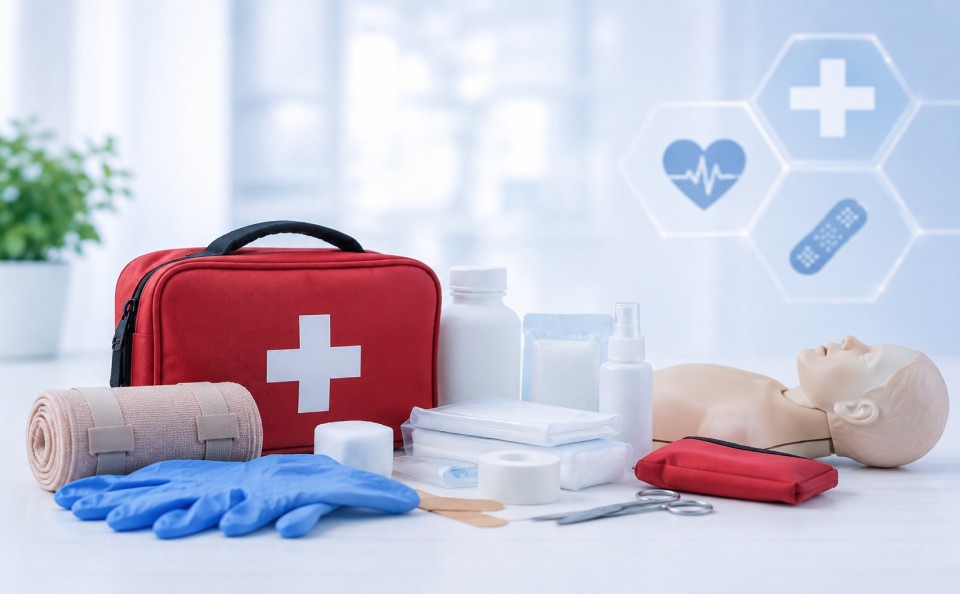
What Should You Keep in a First-Aid Kit?
A basic household or workplace first-aid kit may contain:
- Sterile gauze
- Adhesive bandages
- Clean dressings
- Medical tape
- Disposable gloves
- Antiseptic supplies appropriate for wound care
- Scissors
- Tweezers
- Thermometer
- Emergency contact information
First-aid kits should be checked regularly and expired items replaced.
Common First-Aid Mistakes to Avoid
Good intentions can sometimes cause harm.
Avoid:
Putting toothpaste on burns
It does not provide appropriate burn treatment.
Putting objects into the mouth during a seizure
This can cause injury or choking.
Moving a person unnecessarily after a serious accident
This may worsen spinal or other injuries.
Ignoring severe symptoms because the person appears better
Some serious conditions can temporarily improve before worsening.
Delaying emergency care
First aid is temporary support. It should never delay professional medical treatment when an emergency is suspected.
First Aid for Children
Children are particularly vulnerable to:
- Choking
- Burns
- Falls
- Poisoning
- Drowning
- Head injuries
Parents, teachers, caregivers, and childcare workers should consider learning age-appropriate first aid and CPR.
Children should never be given medication or treatment simply because it was previously used for another illness without appropriate medical guidance.
First Aid for Older Adults
Older adults may have a higher risk of:
- Falls
- Fractures
- Heart disease
- Stroke
- Medication-related emergencies
Family members and caregivers should be familiar with the person’s medical conditions, medications, allergies, and emergency contacts.
When Should You Go Directly to an Emergency Department?
Immediate emergency evaluation may be required for:
- Severe chest pain
- Difficulty breathing
- Sudden weakness or paralysis
- Severe bleeding
- Loss of consciousness
- Serious road traffic injuries
- Major burns
- Severe allergic reactions
- Persistent seizures
- Severe poisoning
- Serious head injuries
- Sudden confusion
- Severe abdominal pain with concerning symptoms
When in doubt about a potentially life-threatening condition, it is safer to seek urgent professional medical assessment.
Emergency Care at East Point Hospital
At East Point Hospital, our Emergency Department provides urgent medical assessment and treatment for patients with acute illnesses and injuries.
Emergency care may involve coordination between:
- Emergency physicians
- General physicians
- Surgeons
- Cardiologists
- Neurologists
- Orthopedic specialists
- Critical care specialists
- Nursing teams
- Diagnostic services
Patients who require advanced monitoring or intensive care can be transferred to the appropriate critical care unit based on their medical condition.
Why First-Aid Training Matters
Knowing what to do during an emergency can reduce panic and help people respond appropriately while professional medical assistance is being arranged.
Schools, offices, factories, healthcare institutions, residential communities, and families can all benefit from basic first-aid and CPR training.
First aid is not about becoming a doctor. It is about knowing the right immediate actions, avoiding harmful interventions, and understanding when professional medical care is urgently required.
Conclusion
Emergencies rarely provide advance warning. A sudden fall, accident, burn, choking episode, seizure, heart attack, or stroke can happen within seconds. Knowing basic first aid can help protect a person’s life and prevent further injury while professional medical care is on the way.
The most important steps are to stay calm, ensure the scene is safe, recognize serious symptoms, call for emergency assistance, provide appropriate first aid, and avoid interventions that may cause harm. At East Point Hospital, we encourage families, schools, workplaces, and communities to develop basic first-aid awareness and emergency preparedness. A few minutes of appropriate action can make a meaningful difference while waiting for professional medical care.